
O Level Economics Books Available
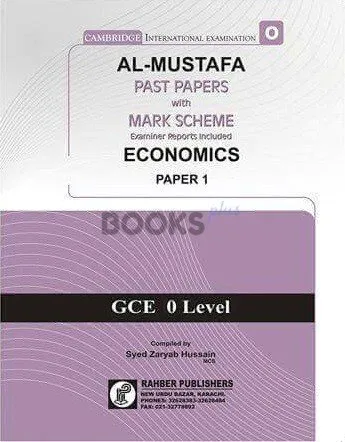
Al Mustafa O Level Economics P1 Unsolved Upto 2024
Original price was: ₨1,500.00.₨1,300.00Current price is: ₨1,300.00.
Al Mustafa O Level Economics P2 Unsolved Upto Nov 2021
Original price was: ₨1,700.00.₨1,500.00Current price is: ₨1,500.00.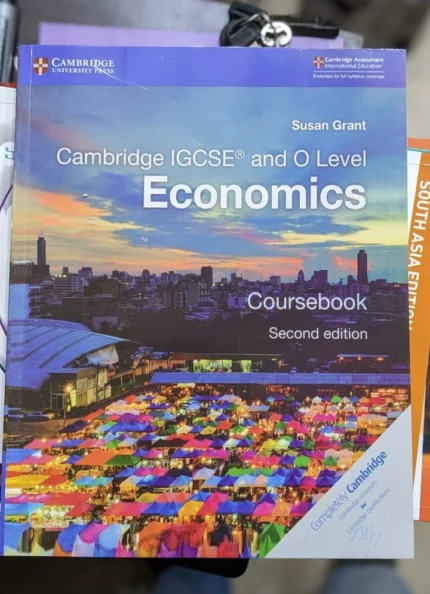
Cambridge IGCSE and O Level Economics Workbook 2nd Edition
Original price was: ₨3,200.00.₨2,100.00Current price is: ₨2,100.00.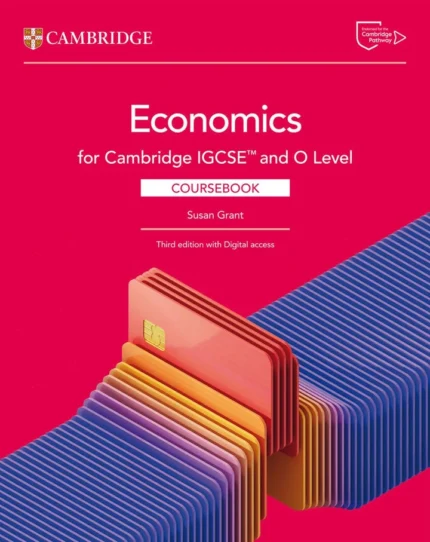
Cambridge IGCSE™ and O Level Economics Coursebook – Third Edition
Original price was: ₨4,500.00.₨3,150.00Current price is: ₨3,150.00.O Level Economics Books in Pakistan — Cambridge O Level & IGCSE Preparation
O Level Economics surprises most Pakistani students who choose it. The subject sounds like common sense — prices go up when goods are scarce, governments tax people to fund public services, businesses compete for customers. Cambridge doesn't test common sense. It tests whether students can apply specific economic concepts and frameworks to given situations, analyse economic data, and evaluate economic arguments from multiple perspectives. Students who go in expecting to discuss economics from personal observation find examination marks considerably lower than their apparent understanding of the subject.
What Cambridge O Level Economics Actually Tests
Cambridge O Level Economics covers basic economic ideas, allocation of resources, microeconomics, macroeconomics, and international trade and development across two papers.
Paper 1 is multiple choice — 30 questions testing knowledge of economic concepts and their application to short scenarios. Questions require precise understanding of economic terminology and relationships. Students who understand what demand curves show, why supply shifts, or how price elasticity affects revenue handle Paper 1 well. Students with general awareness of economic topics find questions that test specific concept application harder than expected.
Paper 2 is structured questions and data response — where most marks sit. A data response section presents economic information through graphs, tables, and written extracts and asks students to interpret it using economic concepts. Structured essay questions require economic analysis and evaluation. Cambridge Economics mark schemes specifically reward responses that use economic terminology accurately, apply relevant concepts to the given context, and evaluate arguments from more than one perspective.
Supply and Demand — The Foundation That Runs Through Everything
Supply and demand is not just one topic in O Level Economics. It runs through every other topic in the subject. Price changes, market equilibrium, government intervention, international trade, exchange rates — all of it connects back to supply and demand analysis. Students who genuinely understand how markets work — why prices change, what causes supply and demand to shift, what happens to equilibrium when either changes — have a foundation that supports every other topic in the course.
Students who memorized supply and demand diagrams without understanding what they show get confused when examination questions apply the same concepts to unfamiliar markets or policy situations. The diagram is not the point. What the diagram represents economically is the point.
Graph Interpretation — Where Pakistani Students Consistently Lose Marks
Cambridge O Level Economics Paper 2 data response sections consistently include economic graphs — supply and demand diagrams, production possibility curves, trade graphs, development indicators. Students who can read graphs accurately and explain what they show in economic terms perform well on data response questions. Students who describe what graphs look like rather than what they mean economically lose marks on every data response question.
"The graph shows a line going up" earns no marks. "The graph shows that as price increases, quantity supplied increases, indicating a positive relationship between price and quantity supplied" earns marks. The economic interpretation matters, not the visual description.
Evaluation in O Level Economics — What Cambridge Actually Rewards
Evaluate questions are where grade boundaries separate most clearly in O Level Economics. Cambridge specifically rewards responses that consider more than one perspective — presenting arguments for and against, considering different stakeholders, and acknowledging that economic outcomes depend on context and assumptions.
"Government price controls reduce prices for consumers" is analysis. "Government price controls reduce prices for consumers in the short run but may create shortages if the price ceiling is set below equilibrium, and the effectiveness depends on the price elasticity of supply and demand in that market" is evaluation. The second response acknowledges complexity and conditions — exactly what Cambridge Economics mark schemes reward.
Students who only present one side of economic arguments consistently cap their marks regardless of how much economics they know. The evaluation habit — considering opposing arguments and reaching a conditional conclusion — develops through deliberate practice on past paper evaluate questions, not through additional reading.
Key Economic Concepts Pakistani Students Need to Know Precisely
Price elasticity of demand and supply appears in almost every examination series — definition, calculation, interpretation, and application to business and government decisions. Students who can calculate elasticity accurately and explain what different elasticity values mean for revenue and tax incidence perform significantly better on these questions than those who only know the definition.
Market failure — public goods, externalities, merit and demerit goods — appears consistently in questions about government intervention. Understanding why markets fail to allocate resources efficiently and what types of government intervention address different types of market failure is what these questions test.
Macroeconomic objectives — economic growth, low inflation, low unemployment, balance of payments equilibrium — and the policy instruments governments use to pursue them appear in the macroeconomics section. The trade-offs between objectives — why reducing unemployment might increase inflation, or why economic growth might worsen the balance of payments — are what evaluation questions in this area specifically test.
O Level Economics & Business Studies — Natural Combination
Economics and Business Studies are frequently combined among Pakistani students — the subjects complement each other in ways that make both more meaningful. Macroeconomic factors like interest rates, inflation, and exchange rates appear in Business Studies as external environment analysis. Students who understand economics properly handle these sections of Business Studies considerably better. Our O Level Business Studies section has preparation material for students combining both subjects.
O Level Economics to A Level
A Level Economics builds directly on O Level foundations — going considerably deeper into microeconomic theory, macroeconomic models, and development economics. Students with genuine O Level understanding find A Level more manageable. Students who passed O Level without it find themselves relearning the same foundations under more time pressure. Our A Level Economics section has past paper collections for students making that transition.
Ordering — What to Know
Cash on delivery available across all cities in Pakistan — Karachi, Lahore, Islamabad, Peshawar, Quetta, Multan, Faisalabad and everywhere else. Dispatch within 2 to 3 working days. Returns within 7 days if something doesn't match your syllabus or examination session.
Common Questions O Level Economics Students Ask
Which topic needs the most preparation? Supply and demand — it runs through every other topic. Students who understand it properly have a foundation that supports the entire course.
How do I improve on evaluate questions? Present both sides of the economic argument and reach a conditional conclusion that acknowledges the outcome depends on specific factors. One-sided answers consistently cap marks below what economics knowledge warrants.
Does O Level Economics help with A Level? Yes directly — A Level builds on O Level foundations. Strong O Level preparation makes the transition considerably more manageable.
COD available? Yes, all cities across Pakistan.
Call or WhatsApp: +92 302 1955110