
O Level Sociology Books Available
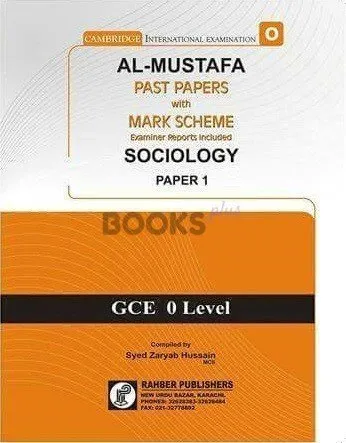
Al Mustafa O Level Sociology P1 Unsolved Upto Nov 2021
Original price was: ₨2,300.00.₨2,000.00Current price is: ₨2,000.00.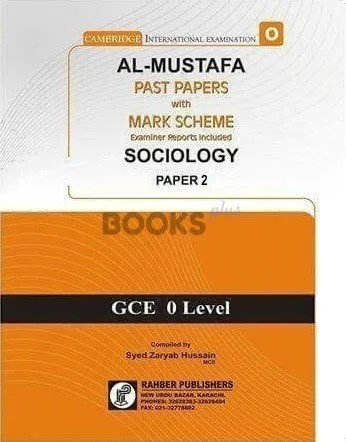
Al Mustafa O Level Sociology P2 Unsolved Upto Nov 2021
Original price was: ₨2,200.00.₨2,000.00Current price is: ₨2,000.00.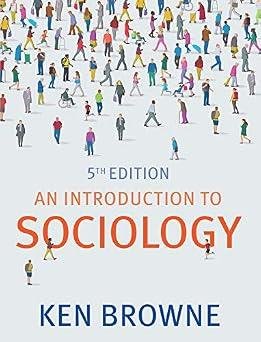
An Introduction to Sociology 5th Edition
Original price was: ₨3,200.00.₨2,800.00Current price is: ₨2,800.00.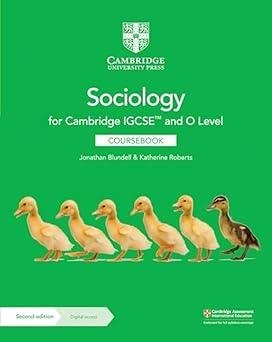
Select options
This product has multiple variants. The options may be chosen on the product page
Cambridge IGCSE and O Level Sociology Coursebook 2nd Edition
Price range: ₨2,700.00 through ₨12,000.00O Level Sociology Books in Pakistan — Cambridge O Level Preparation
O Level Sociology is one of the less commonly offered Cambridge subjects in Pakistani schools — and one of the most underrated. Students who take it often chose it without knowing much about what it covers. Then they realize they're studying something that explains the society they actually live in — family structures, education systems, inequality, crime, media — through frameworks that make these things analytically rather than just experientially understandable. Students who engage with it seriously find it one of the most intellectually interesting O Level subjects available.
What Cambridge O Level Sociology Actually Tests
Cambridge O Level Sociology 2251 covers socialization and identity, social structures, social control, and research methods across two papers. The subject is not common sense dressed up as academic content. It has specific theoretical frameworks — functionalism, Marxism, feminism, interactionism — and specific research concepts that examination questions test with precision. Students who go in expecting to discuss society from personal experience find Cambridge Sociology marks considerably lower than expected.
Paper 1 covers socialization, identity, and social structures — family, education, religion, mass media, and their role in society. Questions test knowledge of sociological concepts and the ability to apply sociological perspectives to given scenarios. The same social phenomenon looks different through different theoretical lenses — a functionalist explanation of the family is different from a Marxist or feminist one — and Cambridge questions regularly ask students to apply specific perspectives rather than give general answers about society.
Paper 2 covers research methods, social inequality, and social control. Research methods questions test understanding of how sociological research is conducted — different methods, their advantages and limitations, ethical considerations, and the debate between quantitative and qualitative approaches. Social inequality questions test knowledge of class, gender, ethnicity, and age as dimensions of inequality and the different sociological explanations for why inequality exists and persists.
Sociological Theory — What Most Students Underestimate
Functionalism, Marxism, feminism, interactionism — these perspectives appear across both papers and across every topic area. Students who treat theory as background context rather than core examination content consistently lose marks on questions specifically designed to test theoretical knowledge and application.
The same institution looks completely different through different perspectives. The family from a functionalist perspective performs positive functions for society — socializing children, providing emotional support, stabilizing adult personalities. The family from a Marxist perspective reproduces class inequality and maintains capitalist social relations. The family from a feminist perspective maintains patriarchal power and disadvantages women. All three perspectives need to be known precisely — what each argues, what evidence supports it, and what its limitations are.
Students who know one or two perspectives and write about those regardless of what the question asks consistently miss marks on questions that specifically ask for a different perspective or a comparison between perspectives.
Research Methods — More Important Than It Looks
Research methods questions appear in Paper 2 and research methods thinking appears in evaluation questions across both papers. Students who treat it as one topic among many underestimate how much it affects overall performance.
Questionnaires, interviews, observation, official statistics, documents — each method has specific advantages and limitations that Cambridge questions test precisely. Structured versus unstructured interviews — what's the difference and when is each more appropriate? Participant versus non-participant observation — what are the ethical issues with each? Official statistics — why do sociologists question their reliability and validity?
The positivism versus interpretivism debate runs through research methods and connects to broader theoretical perspectives. Positivists argue sociology should use scientific quantitative methods to find objective social facts. Interpretivists argue that human social behavior requires qualitative understanding rather than measurement. Knowing this debate and being able to apply it to specific research situations is what research methods questions at the higher mark levels actually test.
Evaluation Questions — Where Grades Separate
Evaluate questions in O Level Sociology require presenting more than one perspective — advantages and disadvantages, or arguments for and against — and reaching a conclusion that weighs the evidence. Students who only present one side of sociological arguments consistently cap their marks regardless of how much sociology they know.
What makes a good sociology evaluation answer is reaching a conclusion that acknowledges complexity — "which perspective is most convincing depends on what aspect of the family you're trying to explain" is better than "therefore functionalism is correct." Cambridge marks context-sensitive evaluation more highly than definitive claims. That's a different habit from what most Pakistani school examinations reward and it takes deliberate practice to develop.
O Level Sociology & Psychology — Related Subjects
Sociology and Psychology both study human behavior but from different angles — Psychology focuses on individual mental processes, Sociology on social structures and group phenomena. Students taking both find the subjects complement each other. Research methods overlap between both subjects, which means preparation for one genuinely supports the other. Our O Level & IGCSE Books section has preparation material across subjects for students combining both.
O Level Sociology to A Level
A Level Sociology builds directly on O Level foundations — going considerably deeper into sociological theory, research methodology, and substantive topic areas. Students with genuine O Level understanding find A Level more manageable. Our A Level Sociology section has preparation material for students making that transition.
Ordering — What to Know
Cash on delivery available across all cities in Pakistan — Karachi, Lahore, Islamabad, Peshawar, Quetta, Multan, Faisalabad and everywhere else. Dispatch within 2 to 3 working days. Returns within 7 days if something doesn't match your syllabus or examination session.
Common Questions O Level Sociology Students Ask
Is Sociology just common sense? No — Cambridge Sociology has specific theoretical frameworks and research concepts that examination questions test with precision. General social awareness helps but targeted examination preparation is still necessary.
Which part needs the most preparation? Sociological theory — functionalism, Marxism, feminism, interactionism. It runs through evaluation questions across both papers and students who don't know perspectives precisely lose marks consistently.
Does O Level Sociology lead to A Level? Yes directly — A Level builds on O Level foundations and goes considerably deeper into sociological theory and research methodology.
COD available? Yes, all cities across Pakistan.
Call or WhatsApp: +92 302 1955110