
Best Books for MBBS 1st Year in Pakistan: What Students Actually Use

Every year around admission season, the same message lands in my inbox in slightly different words: “Which books do I need for first year MBBS?” It sounds like a simple question. It isn’t, because the moment you walk into a medical college you get five different answers from five different seniors, and a sixth from your anatomy professor.
So I’ll try to cut through the noise. First year MBBS in Pakistan revolves around three big subjects: Anatomy, Physiology and Biochemistry. Depending on your university you’ll also deal with subjects like Islamic studies and Pakistan studies, but those three are where your time, energy and book budget go. Here is what I’d honestly suggest for each, and why.
Before you buy anything
Honestly, my advice is boring but it works: don’t buy anything on day one. Every college runs things a little differently. Some follow the modular system, some still go subject by subject, and almost every professor has a book they swear by. I’ve watched students come home with a bag full of titles in week one and then quietly return half of them after the first lecture. Sit through a few classes first. Ask your teachers what they actually want you to read. Then go shopping, and you won’t be paying for books you never open.
Anatomy: the subject that decides your first year
Anatomy is the subject that scares people the most, mostly because of the sheer volume. Nobody finishes it by reading one book once.
The book you’ll hear about first is BD Chaurasia’s Human Anatomy. It comes as a multi-volume set covering the upper limb and thorax, the lower limb, abdomen and pelvis, and head, neck and brain. Many students in Pakistan lean on it because the language is simple and the exam-oriented points are easy to pick out. If your main goal is clearing professional exams with clear, structured notes, this is usually where people start.
Then there’s Snell’s Clinical Anatomy by Regions. Snell is the book that keeps asking “why does this matter in a patient?” The clinical boxes are what make it stand out, and they help a lot later when you start seeing real cases in third and fourth year. Some students find it a bit wordy for the first reading, so I’d suggest it as a companion rather than a replacement.
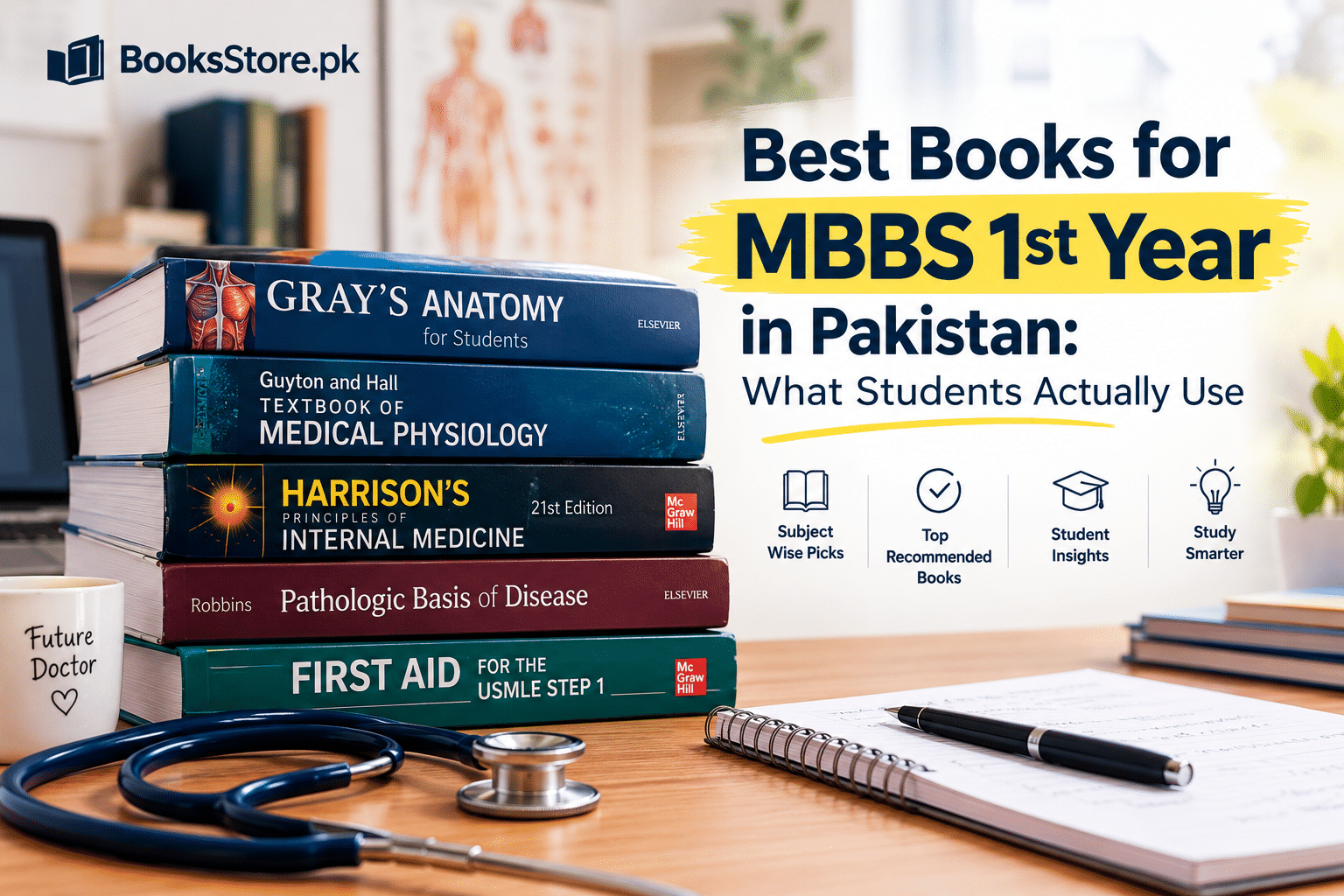
Gray’s Anatomy for Students sits somewhere in between. The illustrations are modern and the clinical correlations are good. It’s a favourite among students who like a more visual, international style of learning.
A few supporting books are worth knowing about. Netter’s Atlas of Human Anatomy is the one almost everyone uses for dissection hall revision, because the illustrations are simply the clearest around. For embryology, Langman’s Medical Embryology is widely used, and for histology many students rely on Junqueira’s Basic Histology. Neuroanatomy often gets its own book too, and Snell’s Clinical Neuroanatomy is a common choice.
My honest suggestion for anatomy: pick one main textbook, add an atlas, and don’t buy all three big names. You will not read them all.
If you want to see what’s available, you can browse our Anatomy books and compare editions.
Physiology: Guyton versus Ganong, and why you may need both
Ask any MBBS student about physiology and the first name you’ll hear is Guyton and Hall Textbook of Medical Physiology. It’s long, detailed and a little heavy, but the explanations are good enough that concepts finally click. If a topic confuses you, Guyton is usually where you go to actually understand it.
Ganong’s Review of Medical Physiology plays a different role. It’s more compact and works well for revision. Plenty of students read Guyton for the first pass and use Ganong when exams are close and time is short. That’s the Guyton versus Ganong debate in a nutshell. It isn’t really a competition. They do different jobs.
For something even more concise, Costanzo’s Physiology is popular with students who want clear explanations without the volume. And in South Asia, books such as Indu Khurana’s Textbook of Medical Physiology and Sembulingam’s Essentials of Medical Physiology are common alternatives, especially for students who prefer a style closer to exam answers.
If I had to give a simple rule: one detailed book for understanding, one short book for revision. That combination covers almost everyone.
Looking for these? Take a look at our Physiology books.
Biochemistry: Harper, Lippincott and the rest
Biochemistry is the subject many students underestimate until the metabolic pathways arrive. Then suddenly everyone is drawing the same diagrams at midnight.
Harper’s Illustrated Biochemistry is the classic reference. It’s thorough and has good clinical correlations, though it can feel dense for a first read. Lippincott Illustrated Reviews: Biochemistry is the other name you’ll hear constantly, and in my experience it’s the more beginner-friendly one. The colourful diagrams and the end-of-chapter questions make pathways easier to remember and test yourself on.
In South Asia, Satyanarayana’s Textbook of Biochemistry is also widely used because it follows a style that suits university exams. And if you want to go deeper into the concepts, Lehninger’s Principles of Biochemistry is a rich resource, though most MBBS students use it as a reference rather than as their main book.
For most students, Lippincott for learning and Harper for reference is a sensible pairing. You can find both and more in our Biochemistry books.
Don’t forget practice material
Textbooks teach you the subject, but exams test you in a very particular way. Once you’ve covered a topic, solving MCQs and past papers is what turns understanding into marks. Many students skip this until it’s almost too late. Start early, even if it’s just ten questions a day, and you’ll notice patterns in how questions are framed. Our MBBS MCQ books has practice material that goes well alongside your main textbooks.
So, what should you actually buy?
If you’re starting out and want a simple setup, here’s how I’d think about it. For anatomy, one main textbook plus an atlas. For physiology, Guyton for depth and a shorter book for revision. For biochemistry, Lippincott or Harper, depending on whether you prefer a lighter or a more detailed read. Add some MCQ practice material and you’re set for most of the year.
And remember that the best book is the one you’ll actually open. A thick, famous textbook that sits untouched on your shelf is worth less than a simpler one you’ve read three times.
If you’re still unsure, check your university’s recommended list first, then explore our full MBBS books to find what fits your course. Good luck with your first year. It’s tough, but it’s also the year that builds the foundation for everything that comes after.